

A linen bread bag is about as simple as kitchen kit gets: a loosely woven flax-fibre bag, usually with a drawstring. It was designed to hold a loaf, and most of them spend most of their lives doing exactly that. But the open weave that keeps a sourdough crust crisp turns out to be useful well beyond the bread bin — for produce, for travel, for packaging, and for a few things you probably wouldn’t guess.
One clarification up front, because it trips people up. This article is about uncoated 100% linen bags. The same shape of bag also comes with a beeswax-coated inner face — we make those as Beeswax Lined Bread Bags — and the coating changes what the bag can do. Plain linen breathes and lets moisture pass through it. A waxed lining adds water resistance and some cling. Different tools, different jobs.
Why linen behaves the way it does
Linen is spun from flax bast fibres, and the weave used for bread bags is deliberately loose. Hold one up and you can see light through it. That open structure does two things:
- Air moves. Moisture evaporating off a warm loaf escapes instead of pooling inside the bag.
- Humidity gets buffered. Linen takes up water vapour and gives it back rather than trapping it at the surface of the food.
The practical result is that a crusty loaf stays crisp outside and soft inside, with far less condensation than you get in a sealed plastic bag. If you want the longer version of how material choice affects that, this piece on which fabrics suit bread bags goes into more depth.
What it doesn’t do is seal. Linen is not moisture-proof, and it isn’t a barrier in either direction — humidity from a steamy kitchen gets in just as easily as it gets out. That single fact decides which of the uses below work well and which don’t.
And linen creases. Permanently. Those wrinkles aren’t wear and they aren’t a defect; they’re the fibre.
Why use linen bread bags? covers the material case in more detail if you’re weighing it against cotton.
What can I use a bread bag for?
Bread and baked goods
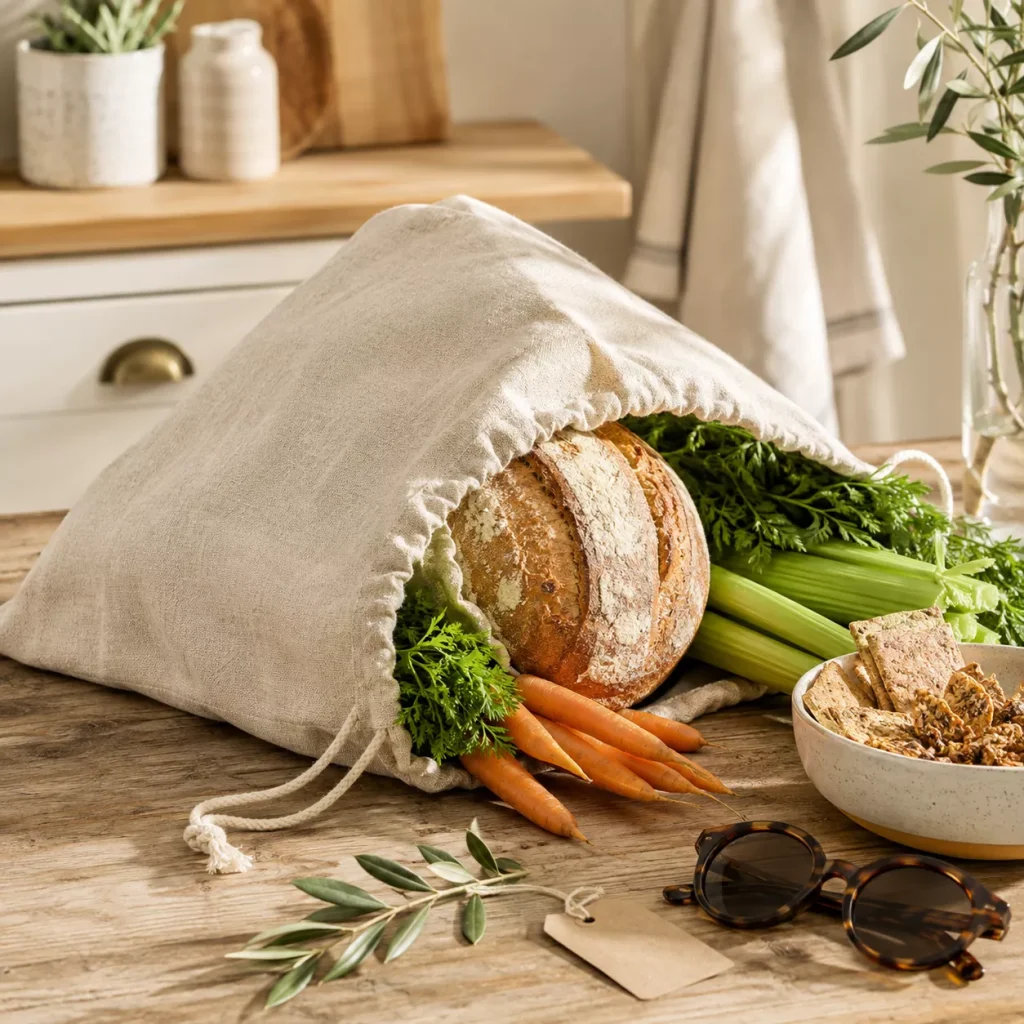
Still the best job for it. Crusty styles — sourdough, country loaves, ciabatta, baguette — are the ones that suffer most in plastic, so they gain the most here. Soft sandwich loaves and enriched doughs gain less: they go stale by drying out, which is precisely what an open weave can’t prevent.
Two habits matter more than the bag itself. Let the loaf cool completely before it goes in, and press the air out before you close it. Trapped air is the usual reason bread spoils quickly in a fabric bag — there’s a whole article on what happens when a bread bag has air in it.
Produce and vegetables
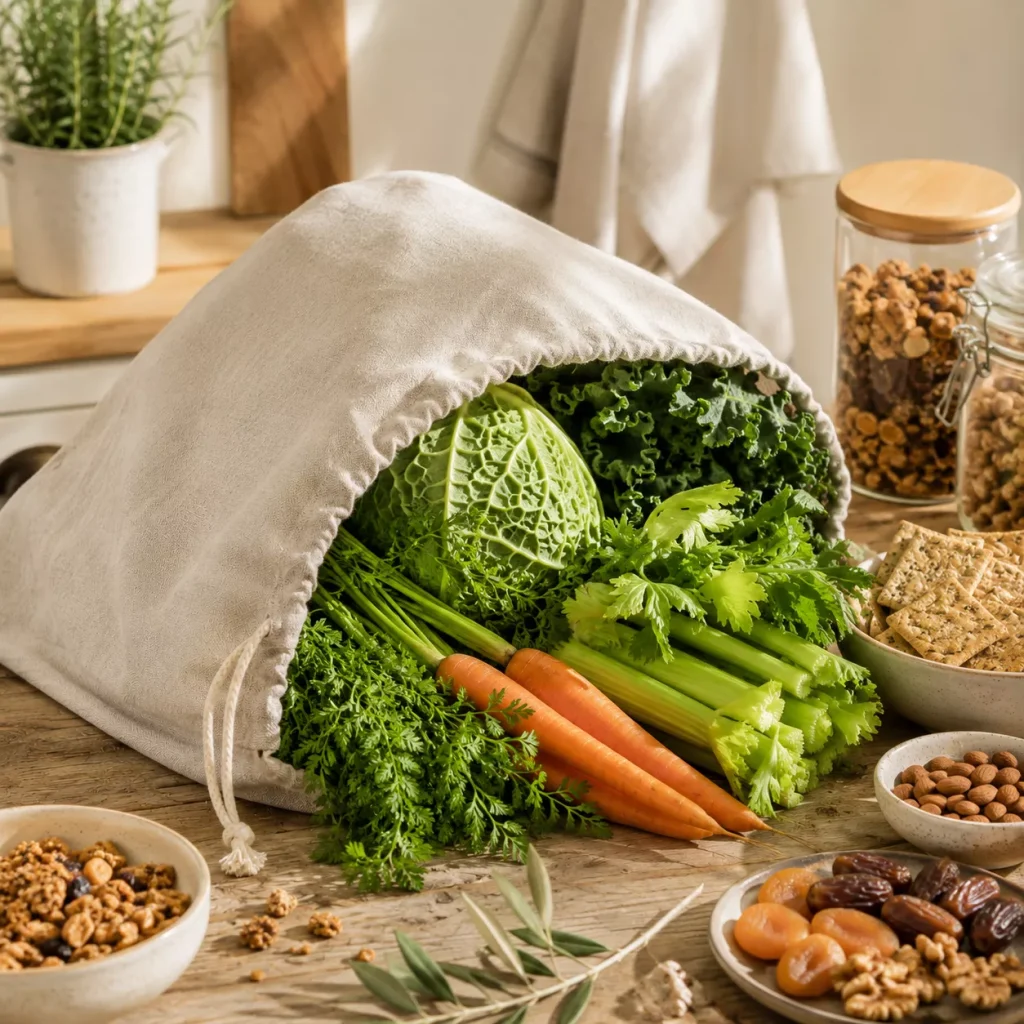
Useful, with a caveat. Hardy greens, root vegetables, carrots, celery, cabbage and bunched herbs all keep noticeably better in linen than in a sealed plastic bag, for the same condensation reason. Very delicate, high-water items — soft berries, tender salad leaves — generally want more humidity than an open weave holds onto, so results there are mixed.
Think of linen as the middle setting: better than plastic for some things, worse than a sealed container for others.
Dry snacks and pantry items
Biscuits, crackers, nuts, dried fruit, granola — anything whose enemy is moisture rather than air. The habit of letting humidity escape is the whole point, and crackers stay crisp because of it.
Two honest limits. It’s a short-term answer measured in days, not the airtight storage you’d want for months. And in a humid climate or a steamy kitchen the bag will eventually settle at the same humidity as the room, so brittle contents do soften in the end.
Sandwiches, snacks and fruit on the go
This is where the no-barrier point bites. Dry items — a sandwich, a handful of nuts, an apple, a wedge of cheese — travel well, and the bag folds flat in your pocket when it’s empty. Anything wet, oily or leak-prone doesn’t: cut fruit, yoghurt, dressed salads.
If your lunch is usually the wet kind, reach for a coated bag instead. Our Vegan Wax Bags are built specifically for sandwiches and snacks on the go, and hold up to semi-moist food in a way plain linen can’t.
Travel and organisation
Cables, chargers, toiletries, sunglasses, a spare pair of socks. The bag weighs almost nothing, folds to nothing, and unlike a plastic pouch it doesn’t trap damp — which makes it a decent home for a wash bag or a not-quite-dry swimsuit.
It isn’t dust-proof and it isn’t padding. Loose small items are fine; anything that needs cushioning needs something else.
Gifts and product packaging
The use most people miss. A printed linen bag reads as a gift in its own right — the natural colour and visible weave do a lot of work that glossy printed paper can’t. Tea, whole spices, chocolate, coffee, homemade biscuits, a bar of soap: all of it looks considered in linen rather than merely wrapped.
For a brand, that’s the interesting part. A bag that gets kept and reused is packaging that keeps working after the sale is done.
Bulk shopping and refill stores
For loose produce, dried goods and refill shopping, one linen bag replaces a steady stream of single-use packaging. Keep expectations realistic about load, though: it’s a bread bag, not a market tote. A few kilos of vegetables is fine; a full weekly shop is not what the seams were rated for.
Household bits and pieces
Sewing kit, shoe care, small tools, jewellery, board-game pieces, that drawer full of cables. Anywhere you want things grouped and visible rather than sealed away.
One correction to a claim that circulates widely: a linen bag does not give moisture-proof protection to whatever’s inside. It buffers humidity, which is a different thing. Storing damp-sensitive gear in one and expecting protection from the air will disappoint you.
What a linen bread bag can’t do
Worth saying plainly, because these are the most common wrong expectations:
- It isn’t a proofing basket. A banneton is rigid, holds the dough’s shape under its own weight, and wicks surface moisture to build a skin that scores cleanly and holds its shape in the oven. A soft, flat-bottomed bag does none of those things. If you want linen in your bread-making, the right tool is a proofing basket with a linen liner — and banneton liners are traditionally linen for exactly the moisture-wicking reason described above. The storage bag is the wrong instrument.
- It isn’t a freezer bag. Freezer air is dry and moving, and an open weave won’t stop freezer burn. Slice and wrap properly first, then bag it.
- It isn’t leak-proof. No lining, no barrier.
Where it is genuinely useful around baking is after the oven: cooling the loaf on a rack, then storing it once it’s completely cold.
If you’re sourcing these: five specification decisions
Most of what determines whether a linen bread bag works for a brand is decided before anything gets sewn. Our custom linen bread bags and the wider reusable bread bag range start from the same five choices:
| Decision | Options | What it actually changes |
| Outer fabric | 100% linen, linen-cotton blend, cotton canvas, poly-cotton, RPET | Breathability and hand-feel against cost and print surface. Linen is the most breathable and the most textured; blends soften it and print more evenly; RPET carries a recycled-content story. |
| Lining | None, beeswax cloth, TPU | Uncoated gives maximum airflow and no barrier. Beeswax cloth adds water resistance and light cling while staying breathable. TPU blocks water and oil and wipes clean. |
| Structure | Flat, or gusseted with bottom and sides | Flat suits baguettes and counter display; a gusseted bag stands on a shelf and holds a round boule without rolling. |
| Closure | Drawstring, zipper, snap/button, velcro | More about channel than function: drawstring reads rustic and giftable, a zipper reassures in retail, snaps are the cheapest to run at volume. |
| Print and packing | Single or double-sided, all-over, spot logo; kraft box, belly band, display box, mailer | Whether the bag lands as a storage product or a gift product — and whether it arrives shelf-ready or needs repacking. |
Common sizes run 30.5 × 43 cm, 32 × 43 cm, 33 × 33 cm and a 20 × 73 cm baguette length, with custom sizes and 3D gusset styles available. Samples take 5–10 days and bulk production 20–35 days, with full OEM, ODM and private label support. Minimum order depends on how far you take the customisation.
One thing worth deciding early: whether the bag is a bread product or a gift product. It changes fabric, print coverage and packaging more than any other single choice, and it’s expensive to change after the first run.
Caring for a linen bag
Wash it every three to four weeks in normal use, sooner if it’s been carrying something greasy. Mild detergent, machine or hand, then air dry — high heat is what shortens the life of any natural fibre bag, and linen is no exception. How often should you wash bread bags? covers the detail.
Linen softens with washing and keeps its strength, so a well-used bag usually feels better than a new one. It will still crease.
Frequently asked questions
Are linen bread bags moisture-proof?
No. They’re breathable, which is almost the opposite. Linen lets moisture pass in both directions and buffers humidity rather than blocking it.
Can I use one as a proofing basket?
No. A proofing basket is rigid and shapes the dough; a soft bag collapses. Use a banneton with a linen liner if you want linen in the process.
Does linen keep bread fresh longer than plastic?
It keeps it different, not simply longer. A crusty loaf stays crisp and avoids the sweaty surface you get in plastic. A soft sandwich loaf will dry out faster than it would in a sealed bag.
What size should I buy?
Match the loaf. Around 32 × 43 cm suits a standard boule or country loaf; 20 × 73 cm is the baguette length; 33 × 33 cm is a good all-rounder for smaller rounds.
Can I machine wash it?
Yes — mild detergent, cool or warm, then air dry away from direct heat. Avoid tumble drying on high.
Is it biodegradable?
Uncoated 100% linen is, yes — it’s a natural plant fibre with no synthetic content. Coated or laminated versions need the lining taken into account.
Can I put a logo on it?
Yes. Linen takes print well, single-sided, double-sided, all-over or spot placement, with eco inks. It’s the single most common reason brands order these rather than buying generic.
Will it work for sandwiches at work?
For dry fillings, yes. For anything with dressing, yoghurt or cut fruit, use a coated bag instead.
This article is general guidance on the use and care of reusable food-contact textiles. It isn’t a substitute for the food safety rules that apply in your market, and it doesn’t replace the care instructions supplied with a specific product. Anyone with allergies or specific dietary requirements should check the material composition of the exact product they’re buying.
 English
  German
  French
  Spanish
  Italian
  Dutch
Dutch