

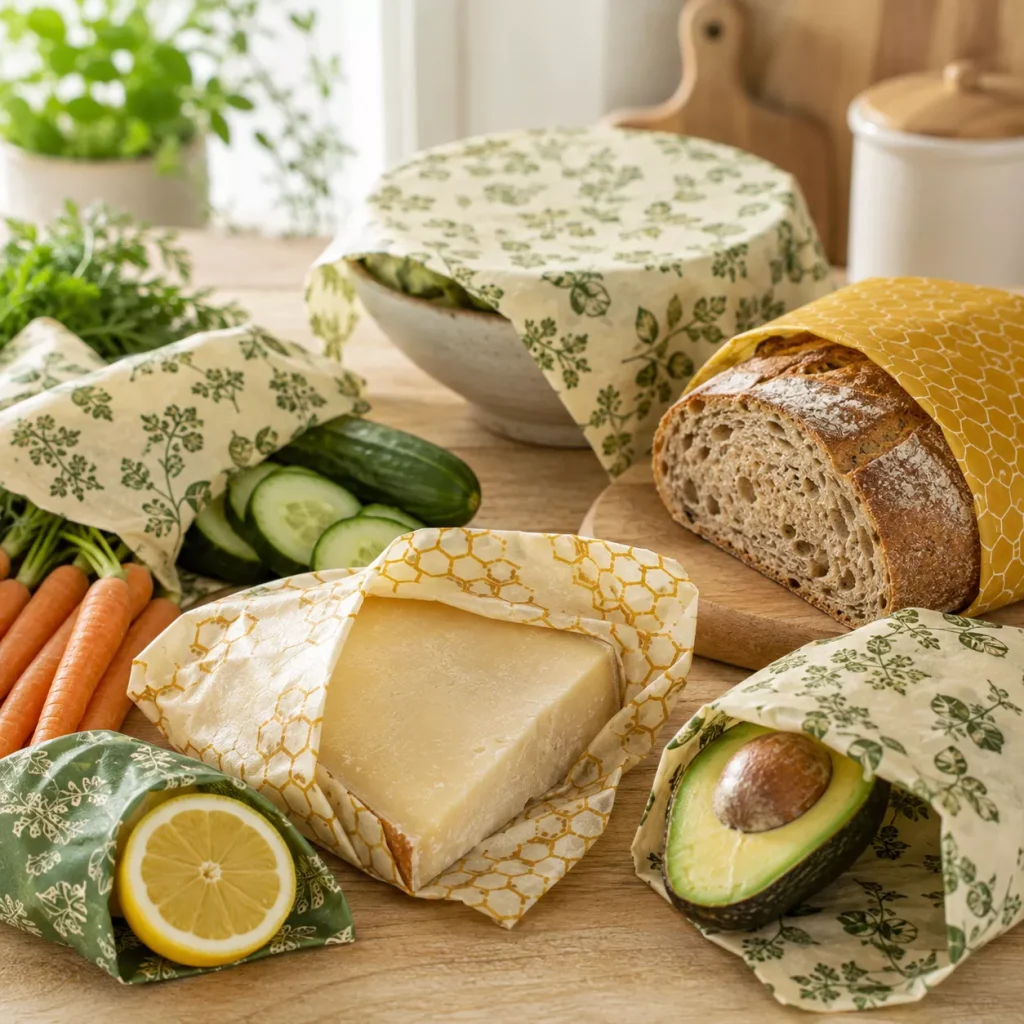
A beeswax wrap is a piece of cotton fabric coated with beeswax, tree resin and a plant oil — usually jojoba. Warm it in your hands and it softens enough to mould around food or press onto a bowl rim; as it cools it holds that shape and grips, with no adhesive and no clip.
That’s the short version. The longer version is worth knowing, because most of the disappointment people have with these comes from expecting them to behave like cling film. They don’t, and they aren’t supposed to.
What’s actually in one
Four materials, each doing a separate job:
- Cotton fabric — the base. Gives the wrap its strength and drape, and the gaps between the woven fibres are what let the finished wrap breathe.
- Beeswax — the moisture barrier. Wax is hydrophobic, so it slows water moving in either direction.
- Tree resin — the tack. This is what lets the wrap grip itself and cling to a smooth rim.
- Jojoba oil — keeps the coated cloth supple so it folds and drapes instead of cracking.
The coating is heated, blended and applied evenly, then cooled so it sets into the weave. The result is water-resistant and breathable — the two properties together are the whole point, and you’ll see why below.
If you want the full mechanism — why it sticks, why heat ruins it, and what actually happens to the food — we’ve broken that out in How Do Beeswax Wraps Work?
What beeswax wraps are good for
In practice, they suit dry and semi-dry food that benefits from a little air movement.
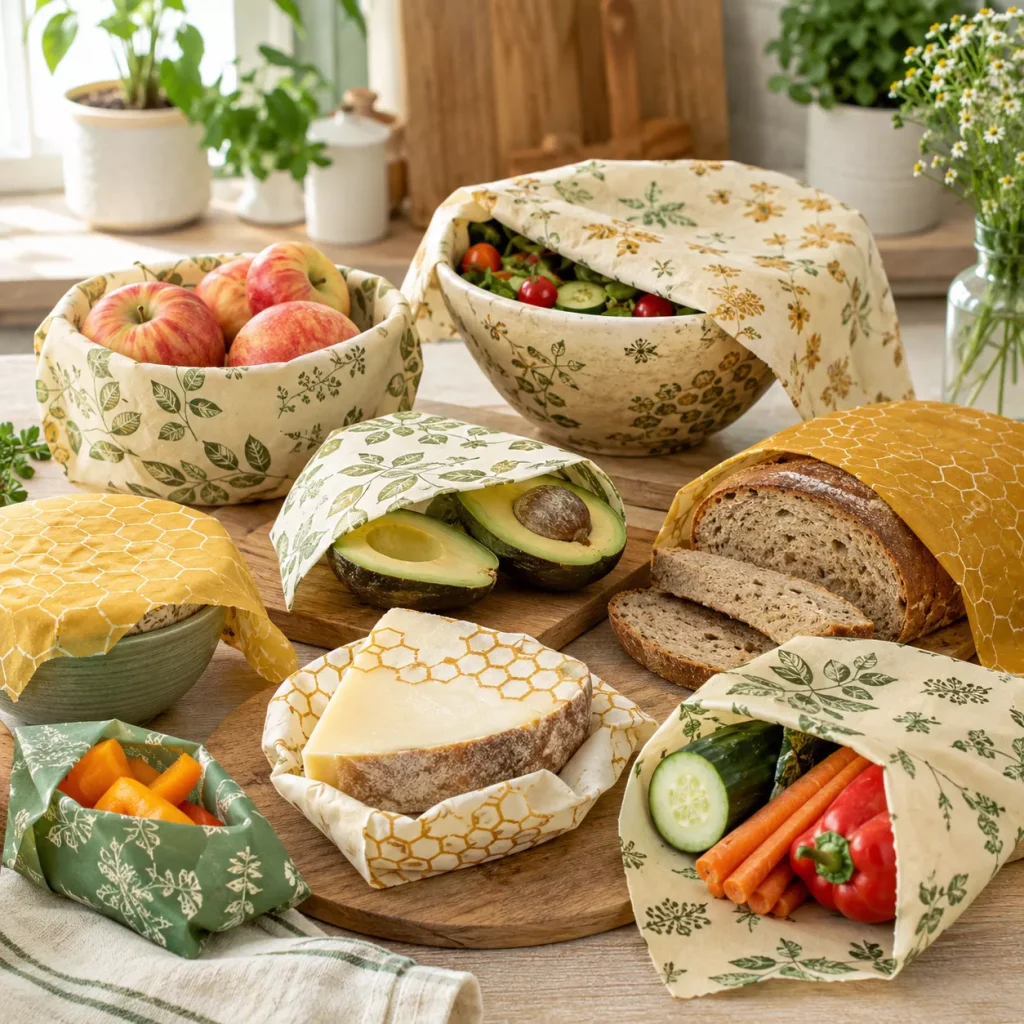
Fruit and vegetables. Apples, cucumbers, carrots, avocados, peppers, celery, lettuce. The wrap slows moisture loss without trapping condensation, which is the failure mode with a sealed plastic bag.
Cheese. Probably the single best use. Cheese wants some air; seal it completely and the surface goes sticky and mould arrives sooner. A wrap sits in the middle.
Bread. Fresh bread keeps releasing moisture. Trap all of it and the crust softens; lose all of it and the loaf goes stale. A bread bag or a wrap holds a middle line — more on that in storing bread without plastic.
Covering bowls. Lay it over and press the edges. It replaces cling film for leftovers, salads, proving dough and fruit platters. Bowl covers do this job as a shaped product with a hemmed edge.
Sandwiches, snacks and lunch. Folded into a pouch, or use a made-for-purpose sandwich bag or snack bag. Dry and semi-dry food is ideal; light oil is fine, liquid is not.
Anything oddly shaped. Half a lemon, a cut onion, a wedge of cheese. This is where a wrap beats any container you own, because it takes the shape instead of you working around it.
Most people start with single wraps or solid colour wraps in a couple of sizes; if you’d rather cut your own lengths, a wrap roll is the flexible option.
What they’re not for
This list matters more than the one above.
- Raw meat. The wrap can’t be washed in hot water, so there’s no way to sanitise it after contact with raw protein. Use glass.
- Raw fish and seafood. Same reason.
- Hot food. Heat softens and lifts the coating. Let food cool to room temperature first.
- Liquids and very wet food. Water-resistant is not watertight. Soups, sauces and juicy cut fruit belong in a container with a lid.
- Microwaves, ovens and dishwashers. All three will destroy the coating — the dishwasher even on the top rack, because the cycle heats the whole cavity.
- The freezer, for long stints. A wrap survives cold fine, so the fridge is exactly what it’s for. Repeated freeze-thaw is what does the damage — the coating comes out brittle and noticeably less tacky. For anything you’re freezing properly, use a container.
Note what isn’t on that list: spicy food. Spice is not heat. A wrap doesn’t care about chilli — it cares about temperature. Hot food is the problem, and it’s the temperature doing it, not the flavour.
Is it food-safe?
When it’s made with food-grade materials, yes — with the same caveat that applies to any reusable food-contact product: it has to be washed between uses, and it has to be kept out of the situations in the list above.
What to look for:
- Food-grade inputs — cotton fabric, food-grade beeswax, food-grade resin, food-grade plant oil.
- Organic cotton, if that matters to your market.
- Plastic-free packaging, which is the point of buying one.
- Test documentation. For food contact, the thing worth asking for isn’t a marketing claim — it’s a test report. Reputable manufacturers can produce food-contact safety reports for their products; if a supplier can’t, that’s information.
One claim to treat carefully: you’ll often see beeswax wraps described as naturally antibacterial. The chemistry is plausible and widely repeated in this category, but “antibacterial” is a claim that needs lab testing to stand behind, not something you can assert because the ingredient list sounds right. The wrap’s real value is managing moisture and air around the food — and it should be washed between uses like any other food-contact item regardless.
How to use one
Simpler than most people expect from the first try:
- Warm it. Press the wrap between your palms for a few seconds. This is the step people skip, and it’s why a wrap “doesn’t work” — cold coating won’t hold a fold.
- Shape it. Around the food, or over the bowl. Fold the edges in and press the seam.
- Let it cool. The coating firms up and holds the shape. That’s the seal.
A new wrap can feel stiff and a bit resistant. Kneading it a few times before the first use softens it up and it settles quickly.
On sizing: small wraps for cheese and half-lemons, medium for sandwiches and cut produce, large for bowls and loaves. Most people end up reaching for medium most often.
Care and how long it lasts
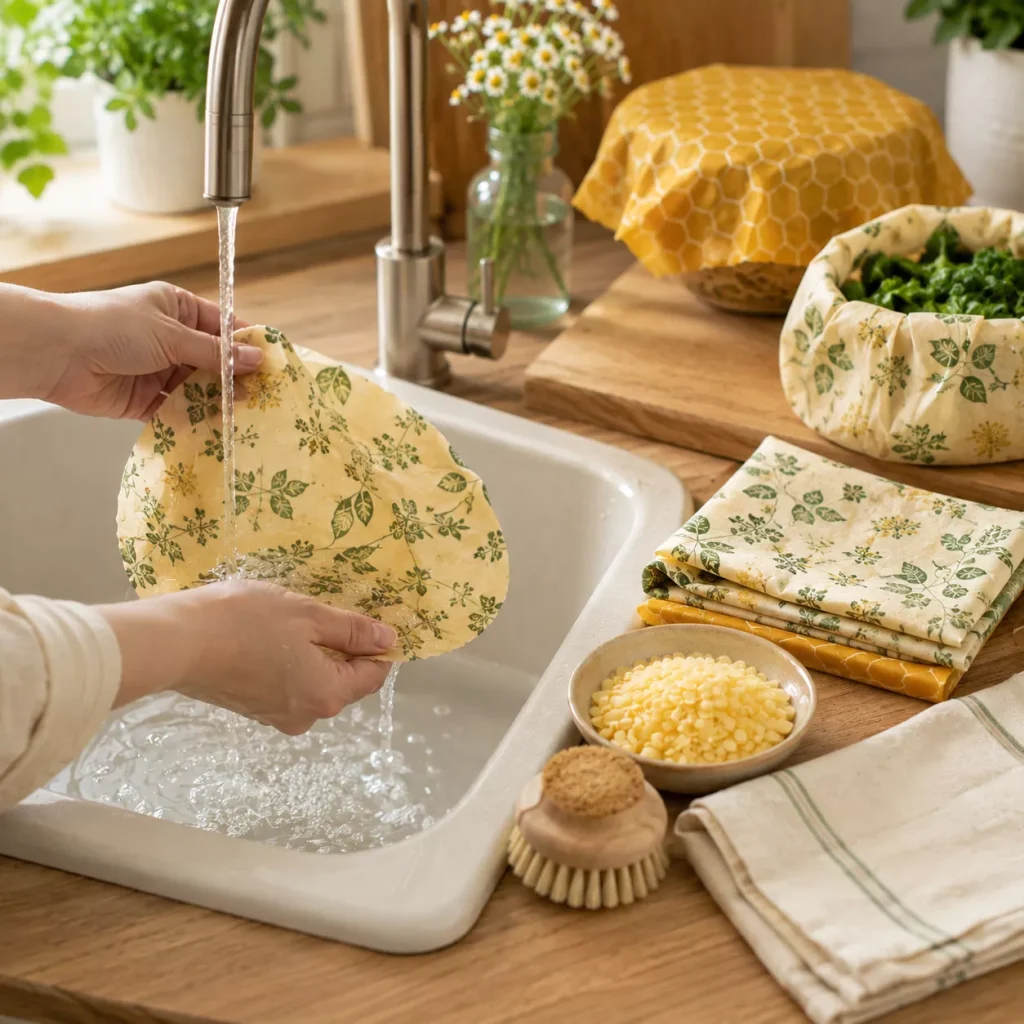
- Wash in cool or lukewarm water with a small amount of mild dish soap. Use a soft cloth or the soft side of a sponge — no scrubbing, which wears through the coating.
- Never hot water. It strips the wax. No dishwasher, no soaking.
- Air dry completely before putting it away. A wrap folded away damp will mildew, and once it’s in the weave you’ll smell it for good.
- Store folded in a drawer, out of direct sun and away from heat.
- Refresh when it loses its grip. Rubbing a beeswax block over a warmed wrap brings most of them back for a second run.
With that kind of care, expect roughly 6–12 months of regular use. Washing temperature and storage heat move that number more than anything else — a wrap that lives above the oven will not see six months. The full routine is in how to store beeswax wraps.
How to choose a good one
If you’re buying a pack for your kitchen, four things are worth checking:
- Materials listed honestly. Cotton, beeswax, jojoba oil, tree resin. If a listing won’t say what’s in the coating, that’s your answer.
- Even coating. The fabric should feel consistently waxy, not patchy, and it should fold without cracking.
- Fabric weight. Too light and it won’t hold a shape; too heavy and it won’t drape.
- Sizing that matches your actual food. A set of one tiny and two huge wraps is less useful than two mediums and a large.
If you’re specifying a product for a brand, the criteria change shape:
- Which foods will the SKU claim? Breathability versus barrier is a positioning decision, not a quality gradient. A wrap tuned for cheese is not the same product as one tuned for sandwiches, and the on-pack copy has to match the formulation.
- What climate is it going into? A formula that behaves in a temperate market can go soft and over-tacky in a hot one, and this matters as much in a shipping container as it does on a shelf. We adjust the wax formula for the market a product will actually be sold and stored in — including the soy wax vegan line, where the ratio gets tuned the same way.
- What claims go on the pack? Antibacterial performance, extended shelf life, a specific number of days — all of these need lab testing on your product for your market. It belongs in the project timeline, not bolted on at the end. We can supply existing food-contact test reports and support additional testing for qualified wholesale orders.
- How will the end customer be told to use it? The most common negative review in this category is “it stopped sticking,” and it’s usually hot water or a dishwasher. A care card that explains why the wrap behaves the way it does will do more for your review score than any amount of packaging design.
Formats, sizes, sets and packaging are all open — sheets, rolls, bags and bowl covers, from 10 × 10 cm to 43 × 58 cm. MOQ, sampling, lead times and documentation are covered in our FAQ, and you can talk to us about a custom run once you know the format and the market.
FAQ
What is beeswax wrap made of?
Cotton fabric coated with a blend of beeswax, tree resin and jojoba oil. No plastic, no adhesive.
How long does it last?
Around 6–12 months of regular use with reasonable care. Avoiding hot water and heat storage is what gets you to the top of that range.
Can I put it in the freezer?
Briefly, yes. Regular freezing is hard on the coating — repeated freeze-thaw makes it brittle and less tacky — so for anything you’re actually storing frozen, use a container.
Is it waterproof?
No, and it isn’t meant to be. It’s water-resistant and breathable, which is the combination that keeps cheese and bread in good condition.
Does it kill bacteria?
Don’t rely on that. The wrap manages moisture and air around the food rather than disinfecting anything, and it should be washed between uses.
Can I use it for raw chicken?
No. The wrap can’t be washed hot, so there’s no way to sanitise it afterwards.
What if it stops sticking?
Warm it in your hands first — that fixes it more often than people expect. If it still won’t hold, the coating has worn down and needs refreshing with a beeswax block.
Does it make food taste of honey?
There’s a faint waxy smell when new, which fades. It doesn’t transfer noticeably.
Is there a vegan version?
Yes — soy wax wraps use plant wax instead of beeswax and work on the same principle, with slightly different care and climate behaviour.
Can I make my own at home?
You can, with cotton fabric and beeswax pellets. It’s a decent weekend project, though the coating is unlikely to be as even as a factory-applied one.
Beeswax wraps are for everyday cold-food storage and short-term covering. They are not suitable for raw meat, raw fish, hot food, or use in microwaves, ovens and dishwashers, and they don’t replace normal food hygiene. If you have a known allergy to beeswax or tree resin, check with a healthcare professional before use.
 English
  German
  French
  Spanish
  Italian
  Dutch
Dutch